
AI model analysis
Kimi K2.7 Code vs o3: Which Model Should Developers Choose?
A developer-focused comparison of Kimi K2.7 Code and o3 across coding evidence, reasoning signals, speed, pricing, and model availability.
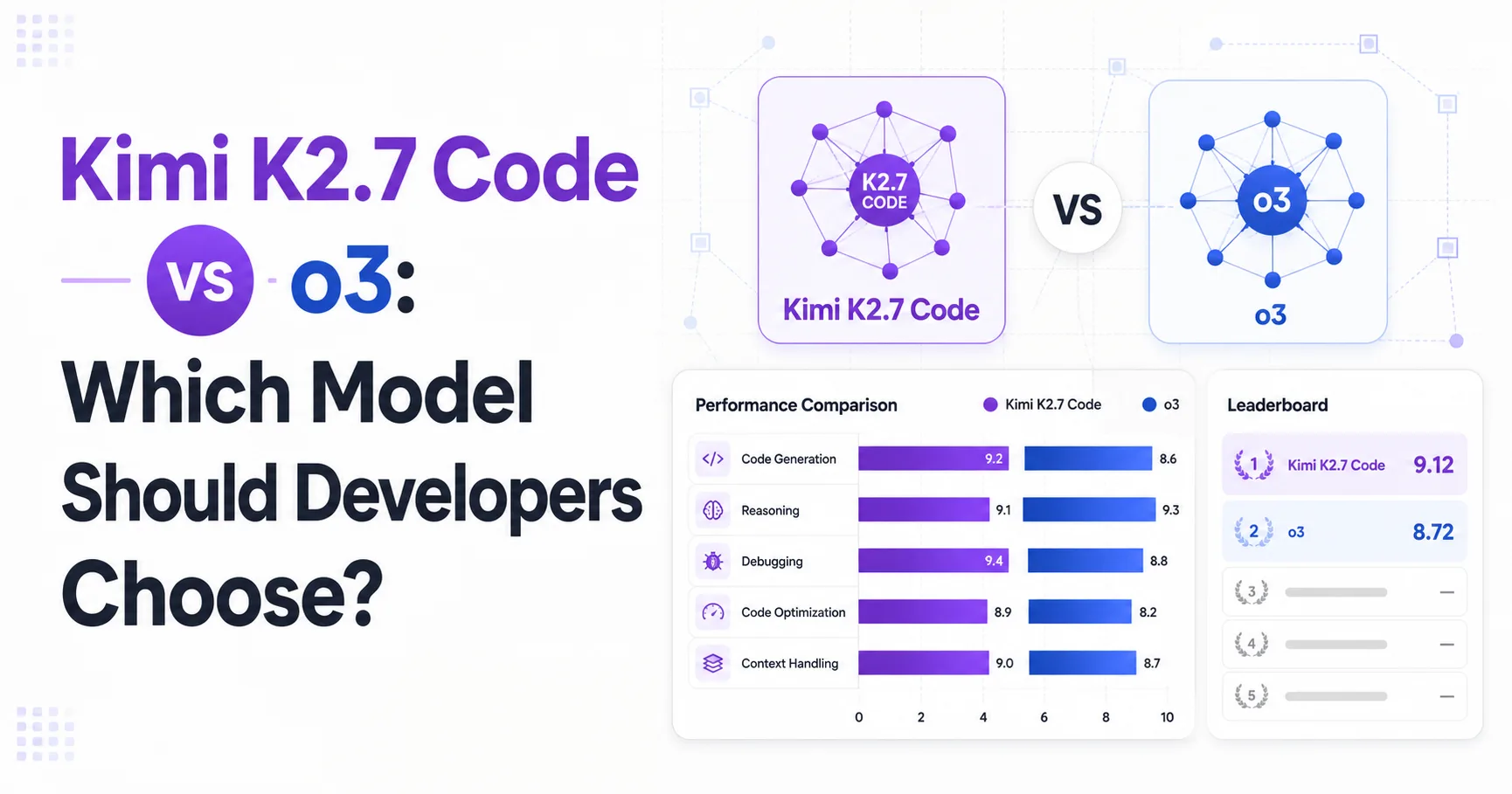
- **Winner overall:** Kimi K2.7 Code, with an Artificial Analysis Intelligence Index of 41.9 vs o3 at 30.4 - **Cheaper:** Kimi K2.7 Code at $1.7125000000000001 vs $3.5 per 1M blended tokens - **Faster:** o3 at 128.056 median output tokens per second - **Pick Kimi K2.7 Code when:** you need lower token costs and the available 60.8 coding index is more relevant than o3's math result - **Watch out:** o3 has an 88.3 math index, while Kimi K2.7 Code has no comparable math result in the supplied data
Kimi K2.7 Code vs o3
Kimi K2.7 Code is the stronger default for cost-sensitive developer workflows, but o3 is the clear choice when response generation speed matters most. The supplied benchmark snapshot gives Kimi K2.7 Code an Artificial Analysis Intelligence Index of 41.9, compared with 30.4 for o3. o3 produces output at 128.056 median tokens per second, while Kimi K2.7 Code records 39.167.
That headline hides a major selection risk: the evidence is incomplete. The snapshot includes a 60.8 coding index for Kimi K2.7 Code, but no comparable coding value for o3. It includes an 88.3 math index for o3, but no comparable math value for Kimi K2.7 Code. Neither model has a supplied context-window value.
The commercial evidence is also uneven. Kimi K2.7 Code has measured prices in the data snapshot. o3 has no current price in the supplied official pricing material. OpenAI’s current model directory does not list o3 among the models shown in the research brief. OpenAI’s pricing page also does not list o3 pricing. Data provided by https://artificialanalysis.ai/.
Executive summary for developers
Kimi K2.7 Code offers the better measured value signal, while o3 offers the better measured speed and math signal. Kimi K2.7 Code’s Intelligence Index is 41.9, which is 11.5 points above o3’s 30.4 in the supplied comparison. That result supports a broad quality advantage within this specific index, but it does not prove superiority for every coding task.
Kimi K2.7 Code also has the only supplied coding result, at 60.8. That number is useful for a developer choosing a model for code generation, repair, or review, yet it cannot establish a head-to-head coding winner because o3’s coding result is missing. A missing comparison value is evidence of uncertainty, not evidence that o3 performs poorly.
o3’s 88.3 math index creates the opposite asymmetry. Developers building code that depends on symbolic reasoning, numerical derivation, or algorithmic explanation may prefer o3, especially if correctness depends on mathematical intermediate steps. The supplied research does not show whether Kimi K2.7 Code can match that result.
Availability is the larger operational concern. The brief found no reliable source confirming a stable o3 alias, current endpoint, or formal successor. It found no reliable source confirming whether Kimi K2.7 Code remains directly callable. OpenAI’s model directory places its current visible frontier-model emphasis on GPT-5.6 Sol, GPT-5.6 Terra, and GPT-5.6 Luna, but the brief does not establish what that means for an existing o3 integration.
Performance: speed changes the product experience
o3 is the speed winner, and its 128.056 median output tokens per second can materially change interactive developer experiences. A faster stream shortens the visible wait after the first token arrives. It can make an IDE assistant feel more responsive during repeated edits, explanations, and test-fix cycles.
Kimi K2.7 Code’s 39.167 median output tokens per second is slower by a wide margin in the supplied snapshot. That gap matters most when the model emits long answers, large patches, or multi-step explanations. It matters less for short responses where network time, tool execution, approval prompts, or repository indexing dominate the total wait.
The latency result does not separate the models. Kimi K2.7 Code and o3 are each listed at 0.3 seconds. That suggests o3’s advantage appears during generation rather than initial request latency. Developers should therefore evaluate the interaction as two phases: time until generation begins, then time spent receiving the answer.
The coding evidence needs careful handling. Kimi K2.7 Code has a 60.8 coding index in the snapshot. o3 has no supplied coding index, so the data cannot answer which model produces better patches, follows repository conventions more reliably, or fixes tests with fewer retries. The research brief also found no verified community testing method for either model. Speed is measurable here; coding behavior is not fully comparable.
Cost: lower rates do not guarantee lower project spend
Kimi K2.7 Code is the cheaper measured option, but its financial advantage depends on whether its slower generation or uncertain availability creates extra work. The supplied blended rate is $1.7125000000000001 per 1M tokens for Kimi K2.7 Code, compared with $3.5 for o3. Kimi K2.7 Code also has lower input and output rates in the snapshot.
A lower token price helps workloads with high request volume, large repositories, or frequent automated retries. It is especially attractive when developers can keep prompts stable and accept the model’s first useful answer. The benefit becomes less certain if a lower-priced response needs more review, more repair calls, or more tool rounds before it is safe to merge.
o3’s missing current official price prevents a complete procurement comparison. The research brief says the official pricing page does not list Standard, Batch, Flex, or Fast mode prices for o3. That means the $3.5 figure is a comparison value in the supplied data, not a verified current purchase quote. Teams should confirm actual account-level availability and billing before committing.
The practical cost question is therefore not simply price per token. It is cost per accepted change. Kimi K2.7 Code is favored when its coding-oriented evidence transfers to the team’s repositories. o3 may still be cheaper in practice if its reasoning reduces failed attempts, but the supplied material does not measure retries, patch acceptance, or engineering time.
Recommendation by developer scenario
Kimi K2.7 Code is the recommended starting point for high-volume coding assistance when measured price and coding evidence matter more than streaming speed. Its 60.8 coding index is the only supplied coding score, and its $1.7125000000000001 blended price is lower than o3’s $3.5 comparison value. That combination makes it the rational first candidate for batch code review, repository Q&A, and routine patch generation, subject to access verification.
o3 is the better candidate for math-heavy engineering tasks and interfaces where generated output must appear quickly. Its 88.3 math index is the strongest specialized result in the supplied data. Its 128.056 median output tokens per second also supports fast interactive feedback. Developers should not interpret that math score as proof of superior general coding performance because the comparable coding result is absent.
Neither model should be selected solely from the supplied materials for a production dependency. The brief does not verify Kimi K2.7 Code’s API status, stable alias, context window, output limit, or known failure modes. It also does not verify o3’s current endpoint, successor, context window, output limit, or current price. OpenAI’s official model documentation and official pricing documentation should be checked during procurement.
A sensible pilot should use the team’s own repositories, fixed prompts, accepted-patch rate, test pass rate, retry count, and end-to-end response time. Those measurements are not present in the research brief, so the final recommendation remains conditional rather than definitive.
Questions to resolve before adoption
o3 remains the more defensible choice for math-sensitive work, while Kimi K2.7 Code remains the stronger measured value choice for coding-oriented experiments. The comparison cannot resolve which model is more dependable in a real repository because only Kimi K2.7 Code has a supplied coding index, at 60.8.
The largest unresolved issue is availability. The research brief found no verifiable official announcement, developer documentation, or pricing page for Kimi K2.7 Code. It also found no official confirmation that o3 remains directly callable, has a stable alias, or has been formally replaced. OpenAI’s current model directory does not list o3 in the supplied research, so teams should treat integration status as an open procurement question.
The second unresolved issue is comparability. o3’s 88.3 math index cannot be directly converted into a coding recommendation. Kimi K2.7 Code’s 60.8 coding index cannot establish a head-to-head advantage without an o3 coding result. Local evaluation is required before production adoption.
Frequently asked questions
Which model should developers choose for general coding?
Kimi K2.7 Code is the better measured starting point for general coding because it has a 60.8 coding index and a lower $1.7125000000000001 blended price, although o3 lacks a comparable coding result.
Which model is faster for interactive developer tools?
o3 is faster for interactive output, with 128.056 median output tokens per second compared with Kimi K2.7 Code at 39.167, while both models show 0.3 seconds of latency.
Is o3 currently available through the OpenAI API?
The supplied research does not confirm current o3 availability, a stable alias, or a replacement version, and the current OpenAI model directory does not list o3.
Is Kimi K2.7 Code definitely cheaper to deploy?
Kimi K2.7 Code is cheaper in the supplied comparison at $1.7125000000000001 versus $3.5 per 1M blended tokens, but extra retries, review effort, or uncertain access could change total project cost.
Which model is better for mathematical reasoning?
o3 has the stronger supplied math signal with an 88.3 math index, while Kimi K2.7 Code has no comparable math result, so the evidence does not support a complete cross-model ranking.
Sources
- OpenAI ModelsChecking the current model directory, visible product positioning, o3 listing status, and official availability evidence.
- OpenAI API PricingChecking current official pricing evidence and the absence of listed o3 Standard, Batch, Flex, or Fast mode prices.
- Artificial AnalysisAttribution for the supplied benchmark, speed, latency, release-date, and pricing snapshot.
Published: