
AI model analysis
MiMo-V2-Omni-0327 vs o3: Which Model Should Developers Choose?
A developer-focused comparison of MiMo-V2-Omni-0327 and o3 across measured intelligence, mathematics, latency, output speed, pricing, and model availability evidence.
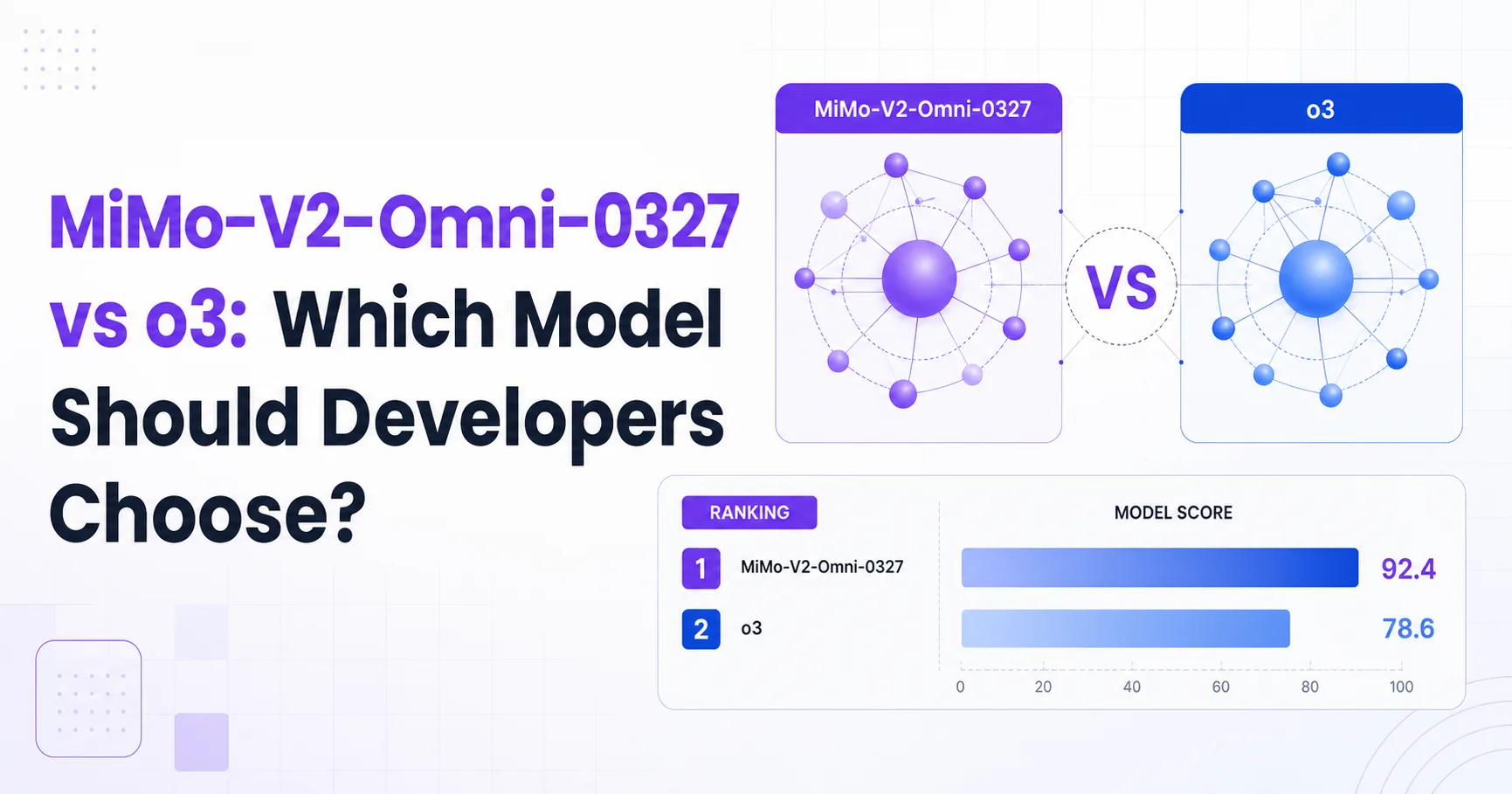
- **Winner overall:** MiMo-V2-Omni-0327, with an Artificial Analysis Intelligence Index of 36.4 vs 30.4 for o3 - **Cheaper:** o3 at $3.5 vs $15 per 1M blended tokens - **Faster measured output:** o3 at 128.056 median output tokens per second; MiMo-V2-Omni-0327 has no reported value - **Pick o3 when:** predictable API economics, measured mathematics performance, and documented OpenAI model visibility matter most - **Watch out:** MiMo-V2-Omni-0327 leads the available intelligence score, but its API identity, limits, and real-world behavior lack supporting source material
MiMo-V2-Omni-0327 vs o3
MiMo-V2-Omni-0327 leads the available intelligence score, while o3 is the safer operational choice because its cost and mathematics evidence are clearer. The Artificial Analysis Intelligence Index scores MiMo-V2-Omni-0327 at 36.4 and o3 at 30.4. The supplied data does not establish whether that six-point difference predicts better coding, tool use, or production reliability. It also reports no context window for either model.
MiMo-V2-Omni-0327 has no verifiable official announcement, developer documentation, pricing page, or community evidence in the research brief. o3 has official OpenAI model and pricing pages, but those pages currently do not list o3. The current OpenAI model directory instead presents GPT-5.6 Sol, GPT-5.6 Terra, and GPT-5.6 Luna as the latest frontier models (OpenAI model directory).
The measured comparison therefore separates two decisions. MiMo-V2-Omni-0327 is the score leader in the supplied intelligence data. o3 is the more defensible choice for a system that needs known billing, a measured mathematics result, and an identifiable vendor context. Data provided by Artificial Analysis.
Executive summary
o3 is the stronger default for most developers because its blended price is $3.5 per 1M tokens, compared with $15 for MiMo-V2-Omni-0327, while its measured mathematics score is 88.3. MiMo-V2-Omni-0327 remains relevant when the available intelligence score is the primary selection signal, since it records 36.4 versus 30.4 for o3.
The comparison has an important evidence asymmetry. MiMo-V2-Omni-0327 has no cited qualitative source at all in the research brief. That absence prevents a reliable conclusion about its coding quality, instruction following, multimodal behavior, tool calling, rate limits, or failure patterns. A higher aggregate score can justify a controlled evaluation, but it cannot by itself justify a production migration.
o3 has more recognizable vendor documentation, yet the official evidence also creates uncertainty. The supplied OpenAI model directory does not list o3, and the supplied pricing page does not list o3 in Standard, Batch, Flex, or Fast mode pricing (OpenAI model directory, OpenAI API pricing). The research brief does not confirm whether o3 remains directly callable, has a stable alias, or has been formally replaced.
For selection, treat MiMo-V2-Omni-0327 as a score-led candidate requiring validation. Treat o3 as a cost-led candidate requiring availability confirmation. Neither model has a reported context window in the supplied data, so long-document workflows cannot be selected confidently from this comparison alone.
Performance: score leadership does not equal task leadership
MiMo-V2-Omni-0327 is the measured intelligence leader, but o3 is the only model with a reported mathematics score and output-speed figure. The available intelligence score is 36.4 for MiMo-V2-Omni-0327 and 30.4 for o3. That result supports testing MiMo-V2-Omni-0327 for broad reasoning workloads, but it does not show which model writes better code, invokes tools more reliably, or produces fewer production errors.
The mathematics evidence favors o3 within the supplied dataset. o3 records an Artificial Analysis Math Index of 88.3, while MiMo-V2-Omni-0327 has no reported value. This is not a complete head-to-head mathematics result because the missing MiMo-V2-Omni-0327 value makes the comparison one-sided. Developers should therefore avoid describing o3 as mathematically superior in absolute terms. The defensible claim is narrower: o3 has evidence for mathematics performance, and MiMo-V2-Omni-0327 does not in this brief.
Both models show a reported latency of 0.3 seconds, so the latency evidence does not separate them. o3 reports 128.056 median output tokens per second, while MiMo-V2-Omni-0327 has no reported output-speed value. The result is evidence of a measured o3 throughput figure, not proof that o3 is faster in every deployment.
The missing facts matter more for interactive systems than the aggregate score. The research provides no verified context window, output limit, multimodal specification, API parameter set, or failure case for either model. OpenAI’s current model documentation also does not provide those o3 details in the supplied evidence (OpenAI model directory). A developer-facing benchmark should test the exact prompts, tool calls, response schemas, and retry behavior used by the application.
Cost: o3 wins the listed economics, but workload shape can change the decision
o3 is the clear cost leader on every listed token price, making MiMo-V2-Omni-0327 difficult to justify for high-volume traffic without a quality benefit that matters to the application. The blended price is $3.5 per 1M tokens for o3 and $15 for MiMo-V2-Omni-0327. Input pricing is $2 versus $10, and output pricing is $8 versus $30.
The practical implication is workload sensitivity. Applications dominated by repeated prompts, retrieval context, or long generated answers expose the price gap differently, but the supplied data does not include token-mix assumptions beyond the reported blended metric. Developers should compare expected input and output proportions against the application’s real traces before treating the blended figure as a forecast.
MiMo-V2-Omni-0327 could still be cheaper in practice if its higher intelligence score materially reduces retries, human review, tool failures, or multi-step orchestration. The research brief provides no evidence for any of those operational effects. Without such evidence, the higher listed price remains a direct cost disadvantage rather than an investment with a demonstrated payback.
o3’s cost advantage also requires a deployment check. The supplied official OpenAI pricing page does not list o3’s current Standard, Batch, Flex, or Fast mode price (OpenAI API pricing). The data brief supplies $3.5, $2, and $8 as comparison values, but the research cannot confirm that these are currently purchasable prices. The right conclusion is therefore conditional: o3 is cheaper in the provided dataset, while current production billing availability remains unverified.
Neither model should be selected from price alone. If a task needs repeated verification or expensive downstream actions, the lower token price may not produce the lower total system cost. That total-cost claim is also evidence-deficient here and needs an application-specific pilot.
Recommendation for developer model selection
o3 is the recommended starting point for cost-sensitive production experiments, provided its current API availability and price are confirmed before implementation. o3 combines the lower supplied blended price of $3.5 per 1M tokens with a reported Math Index of 88.3 and a reported median output speed of 128.056 tokens per second. Its reported latency is 0.3 seconds, equal to MiMo-V2-Omni-0327 in the supplied data.
Choose MiMo-V2-Omni-0327 for a targeted evaluation when the Artificial Analysis Intelligence Index is central to the workload. Its score of 36.4 exceeds o3’s 30.4, so it deserves testing in broad reasoning, classification, or agentic tasks where that index is relevant. The evidence does not establish that the score advantage transfers to coding, structured output, multimodal input, or tool execution.
Use a two-stage decision process. First, confirm that the model can be called under the required API name, limits, authentication flow, and billing terms. The OpenAI model directory currently does not list o3, and the research brief contains no verifiable official product material for MiMo-V2-Omni-0327 (OpenAI model directory). Second, run representative application tests with correctness, retries, latency, output length, and total workflow cost.
Do not make a final choice for long-context or multimodal systems from this comparison. Context windows and multimodal capabilities are unreported for both models. Do not claim that MiMo-V2-Omni-0327 is more reliable or that o3 is officially discontinued, because the supplied sources do not support either conclusion.
What the evidence cannot answer yet
MiMo-V2-Omni-0327 cannot be treated as production-ready from the supplied evidence because no verifiable documentation describes its interface, limits, or failure behavior. o3 cannot be treated as currently available solely because it has measured benchmark and pricing values in the data brief. The official OpenAI pages supplied for verification do not list o3 in the current model directory or pricing page (OpenAI model directory, OpenAI API pricing).
The unresolved questions are practical rather than cosmetic. Developers still need to verify API identifiers, authentication, context limits, output limits, supported modalities, rate limits, deprecation status, and billing terms. The research brief also contains no reliable community discussions or reproducible failure cases for either model. These gaps mean that a small, representative evaluation is necessary before committing application architecture to either model.
The strongest defensible decision today is conditional. o3 is the economical candidate with more measurable task evidence. MiMo-V2-Omni-0327 is the intelligence-score candidate with substantially weaker documentation evidence. The comparison should guide test prioritization, not replace deployment validation.
Frequently asked questions
Is MiMo-V2-Omni-0327 better than o3 overall?
MiMo-V2-Omni-0327 leads the supplied Artificial Analysis Intelligence Index at 36.4 versus 30.4 for o3, but the evidence does not prove better coding, reliability, tool use, or production behavior. o3 has the only reported mathematics result, 88.3, while MiMo-V2-Omni-0327 has no reported mathematics value. The safest conclusion is that MiMo-V2-Omni-0327 wins one available aggregate signal, not the complete developer decision.
Which model is cheaper for API usage?
o3 is cheaper in the supplied data, at $3.5 per 1M blended tokens versus $15 for MiMo-V2-Omni-0327. Its listed input price is $2 and its output price is $8, compared with $10 and $30 for MiMo-V2-Omni-0327. However, the supplied OpenAI pricing page does not currently list o3, so developers must confirm that these values still correspond to a callable production offering.
Which model is faster?
o3 is the only model with a reported median output speed, at 128.056 tokens per second, while MiMo-V2-Omni-0327 has no reported output-speed value. Both models have a reported latency of 0.3 seconds, so latency is tied in the supplied data. The evidence supports saying that o3 has measured throughput data, not that it is universally faster in every deployment or workload.
Can developers use this comparison to choose a long-context model?
Developers cannot choose a long-context winner from this comparison because the supplied data reports no context window for either MiMo-V2-Omni-0327 or o3. The research brief also does not provide verified output limits, API parameters, or multimodal specifications. A long-document application should confirm those limits directly through current provider documentation and then test truncation, retrieval quality, latency, and total cost with representative inputs.
Is o3 still available through the OpenAI API?
The supplied evidence does not confirm that o3 is still directly callable through the OpenAI API. The current OpenAI model directory provided in the research brief does not list o3, and the brief does not identify a stable alias, endpoint, or formal replacement. Developers should verify current availability, model naming, deprecation status, and pricing before designing a production integration around o3.
Sources
- Artificial AnalysisSupplying the comparison data and benchmark attribution for the reported intelligence, mathematics, latency, output-speed, release-date, and pricing values.
- OpenAI ModelsVerifying the current OpenAI model directory, o3 visibility, and the absence of supplied official o3 interface and availability details.
- OpenAI API PricingVerifying the current OpenAI pricing page and the absence of supplied current o3 pricing entries.
Published: