
AI model analysis
Motif 3 (Beta) vs o3: Which Model Should Developers Choose?
A developer-focused comparison of Motif 3 (Beta) and o3 across measured intelligence, coding and math signals, latency, speed, pricing, and deployment confidence.
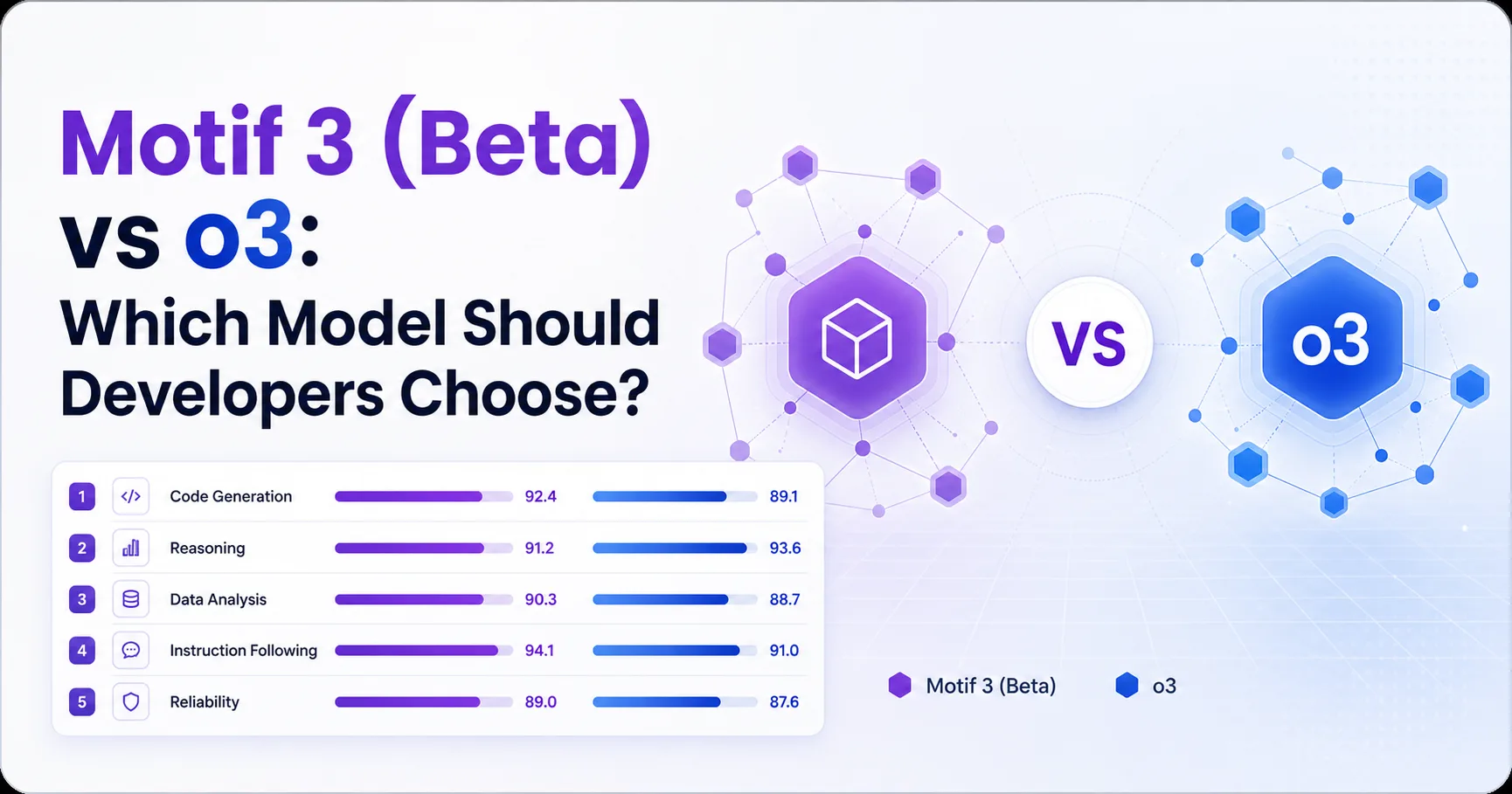
- **Winner overall:** o3, with a $3.5 blended-token price, 128.056 median output tokens per second, and a measured 88.3 math index - **Cheaper:** o3 at $3.5 vs $15 per 1M blended tokens - **Faster:** o3 at 128.056 (median output tokens per second) - **Pick Motif 3 (Beta) when:** the measured 44.1 intelligence index and 62 coding index match your evaluation priorities - **Watch out:** neither model has a complete directly comparable benchmark and deployment-status record in the supplied sources
Motif 3 (Beta) vs o3
o3 is the safer default for production-minded developers because it combines a lower measured price with a reported output-speed signal and a strong math result. Motif 3 (Beta) has the higher Artificial Analysis Intelligence Index, but its supplied record lacks a comparable speed value, a math result, official documentation, and a verified deployment status. The available data therefore supports a practical recommendation, not a universal capability verdict.
The comparison is especially uneven because the two models do not have the same evaluation coverage. Motif 3 (Beta) has an Artificial Analysis Intelligence Index of 44.1 and a coding index of 62. o3 has an Artificial Analysis Intelligence Index of 30.4 and a math index of 88.3. The supplied comparison does not provide a head-to-head coding score for o3 or a math score for Motif 3 (Beta).
The quantitative figures in this article are provided by Artificial Analysis. Official OpenAI references are limited to the current model directory and API pricing page.
Executive summary for developers
o3 offers the stronger default selection case, while Motif 3 (Beta) offers the stronger measured general-intelligence signal in the supplied snapshot. That split matters because model selection is usually a deployment decision, not a contest for one aggregate score.
| Decision factor | Motif 3 (Beta) | o3 | What it means |
|---|---|---|---|
| Artificial Analysis Intelligence Index | 44.1 | 30.4 | Motif leads on the supplied aggregate intelligence measure |
| Coding index | 62 | Not provided | Motif has a coding signal, but no direct comparison is available |
| Math index | Not provided | 88.3 | o3 has a math signal, but Motif cannot be ranked on it |
| Latency | 0.3 seconds | 0.3 seconds | The supplied latency figures are tied |
| Blended price per 1M tokens | $15 | $3.5 | o3 has the lower listed blended price |
Motif 3 (Beta) looks attractive for teams whose own testing confirms broad reasoning or coding quality. Its measured intelligence score is 13.700000000000003 points above o3 in the supplied comparison. That advantage should not be treated as proof that Motif wins every developer workflow, because the benchmark categories are incomplete and the source does not describe the test methodology in the supplied brief.
o3 is easier to justify where cost discipline, math-heavy work, and measured response speed matter. Its output-speed value is 128.056 median output tokens per second, while Motif has no supplied value for that field. The equal latency value means faster generation should not be confused with faster request start-up.
Performance: what the scores mean in real work
Motif 3 (Beta) leads the supplied intelligence index, but o3 provides the more actionable performance profile for teams that need math and generation-speed evidence. Motif records 44.1 on the Artificial Analysis Intelligence Index and 62 on the coding index. o3 records 30.4 on the intelligence index and 88.3 on the math index.
The practical implication is that Motif deserves a serious task-level trial for broad coding or reasoning workflows, especially if the coding index reflects the work your team actually ships. The evidence does not establish how o3 would rank on the same coding evaluation. It also does not establish how Motif would rank on the same math evaluation. A developer should therefore avoid converting the visible scores into a single universal capability ranking.
The clearest operational signal favors o3 for workloads where generated output volume affects user experience. o3 reports 128.056 median output tokens per second, while Motif has no supplied output-speed value. Both models report 0.3 seconds of latency. That tie suggests that the main visible difference may occur after generation begins, but the supplied materials do not define the latency measurement or explain whether it represents time to first token, end-to-end response time, or another metric.
For interactive coding assistants, output speed can shape perceived responsiveness after the request starts. For batch evaluation, speed may matter less than answer quality and price. For math-heavy automation, o3 has a relevant measured signal. For general coding, Motif has a relevant measured signal, but the missing o3 coding result leaves the decision unresolved.
The performance figures come from Artificial Analysis. No supplied source verifies either model’s community coding experience, failure modes, context window, output limit, or multimodal behavior.
Cost: the cheaper model can change the architecture
o3 is the clear cost choice because its supplied blended price is $3.5 per 1M tokens versus $15 for Motif 3 (Beta). The difference is large enough to influence routing, retry policy, evaluation volume, and whether developers can afford to use the model as a first-pass system.
The listed input price is $2 per 1M tokens for o3 and $10 for Motif. The listed output price is $8 for o3 and $30 for Motif. Output-heavy workflows are especially exposed to the gap because generated code, explanations, test cases, and structured results can consume substantial output tokens. A team that selects Motif for quality reasons should measure whether its task success rate reduces retries enough to offset the higher unit price.
The cheaper option can become more expensive in practice if it requires additional calls, human review, or fallback routing. The supplied data does not measure success rates, retry rates, review time, or production error costs, so that break-even point cannot be calculated here. Developers should treat the price comparison as a unit-cost result, not as a complete total-cost-of-ownership result.
Cost also affects experimentation. o3’s lower listed prices make it easier to run larger regression suites, compare prompts, and add verification calls within a fixed budget. Motif may still be justified when a team has evidence that its intelligence or coding performance materially reduces downstream work. That evidence must come from the team’s own representative tasks because the supplied sources do not provide a validated conversion from benchmark score to engineering cost.
The listed figures are provided by Artificial Analysis. The current OpenAI pricing page does not list o3 in the supplied research brief, so the data snapshot price should not be presented as a currently verified official OpenAI price.
Recommendation: choose by evidence quality and workload
o3 is the recommended starting point for most developers who need a cost-aware, math-capable, responsive model with a clearer measured operating profile. Its $3.5 blended price, 128.056 median output tokens per second, 0.3-second latency, and 88.3 math index create a concrete basis for a first production trial.
Choose Motif 3 (Beta) when your workload is dominated by broad reasoning or coding tasks and your evaluation confirms that its 44.1 intelligence index and 62 coding index translate into better accepted outputs. Motif’s higher intelligence score is the strongest argument for testing it. The case remains conditional because the supplied research brief contains no verified vendor site, developer documentation, pricing page, stable alias, availability statement, or community testing for Motif.
The official OpenAI model directory supplied for this comparison lists GPT-5.6 Sol, GPT-5.6 Terra, and GPT-5.6 Luna as current frontier models, but does not list o3. The same source does not verify o3’s current API endpoint, stable alias, context window, output limit, or multimodal capabilities. The OpenAI model directory therefore reduces confidence in current availability, even though the data snapshot contains performance and price fields for o3.
A sensible selection process is to run both models on the same private task set, record accepted-output rate, repair calls, latency distribution, and token usage, then compare the result against the unit prices. The supplied evidence does not provide those production measurements. Until they exist, o3 is the practical default, while Motif remains a potentially stronger specialist candidate that requires verification before adoption.
FAQ before you choose
o3 is the best initial choice for teams that prioritize price, math evidence, and measurable response speed, while Motif 3 (Beta) remains worth testing for coding and broad-intelligence workloads. The supplied evidence cannot verify a complete production comparison.
Frequently asked questions
Which model is cheaper, Motif 3 (Beta) or o3?
o3 is cheaper at $3.5 per 1M blended tokens versus $15 for Motif 3 (Beta). Its listed input and output prices are also lower, but real savings depend on retries and task success.
Which model is better for coding?
Motif 3 (Beta) has the only supplied coding score, 62, so it has the stronger visible coding signal. The evidence is insufficient to declare a winner because o3’s comparable coding result is not provided.
Which model is better for math-heavy developer workflows?
o3 has the stronger available math evidence because its Artificial Analysis Math Index is 88.3. Motif 3 (Beta) has no supplied math score, so the comparison cannot establish whether o3 would win every math task.
Is Motif 3 (Beta) faster than o3?
The supplied evidence does not show that Motif 3 (Beta) is faster. Both models have 0.3 seconds of latency, while only o3 has a reported median output speed of 128.056 tokens per second.
Can developers safely use o3 in a new production integration?
The supplied evidence does not fully confirm that o3 is currently available for a new integration. OpenAI’s current model directory does not list o3, and it does not provide a verified stable alias or endpoint in the supplied material.
Why might a team still choose Motif despite its higher price?
A team might choose Motif if representative tests show that its 44.1 intelligence index and 62 coding index produce more accepted outputs or fewer repair calls. The supplied research does not measure that production advantage.
Sources
- Artificial AnalysisAll quantitative model metrics, pricing figures, latency, output speed, release dates, and evaluation values in the data snapshot.
- OpenAI ModelsCurrent OpenAI model directory, model visibility, product-line positioning, and the absence of supplied o3 availability details.
- OpenAI API PricingChecking whether the supplied current official pricing page lists o3 and verifying the absence of a supplied official o3 price.
Published: