
AI model analysis
Muse Spark vs o3: Which Model Should Developers Choose?
A developer-focused comparison of Muse Spark and o3 covering measured capability, speed, pricing, documentation, and production risk.
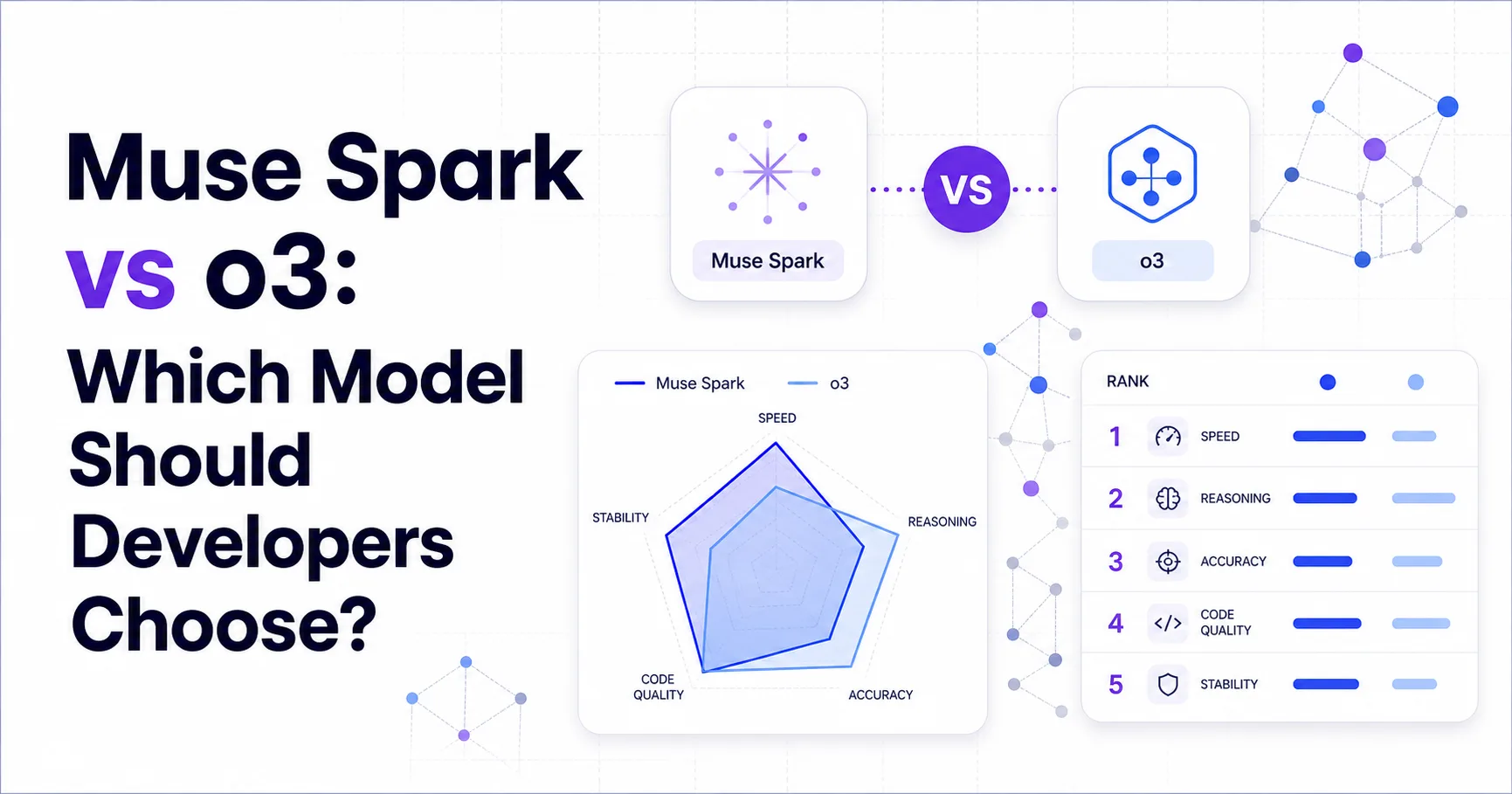
- **Winner overall:** Muse Spark, with a 43.1 Artificial Analysis Intelligence Index vs o3 at 30.4 - **Cheaper:** o3 at $3.5 vs $15 per 1M blended tokens - **Faster:** o3 at 128.056 median output tokens per second, while Muse Spark has no reported value - **Pick Muse Spark when:** measured general intelligence and the available coding signal matter more than price or documentation maturity - **Watch out:** Muse Spark has no verified public Meta documentation, while o3 is absent from OpenAI's current model and pricing pages
Muse Spark vs o3
Muse Spark is the stronger measured general-intelligence option, while o3 is the safer documented value choice for production selection. The available Artificial Analysis snapshot gives Muse Spark an Intelligence Index of 43.1, compared with 30.4 for o3. The same snapshot reports a coding score of 58.6 for Muse Spark and a math score of 88.3 for o3, but it does not provide matching scores for either comparison. That makes the headline result useful, but incomplete.
The commercial result is clearer. o3 costs $3.5 per 1M blended tokens, compared with $15 for Muse Spark. o3 also has the only reported output-speed value, 128.056 median output tokens per second. Both models show 0.3 seconds of latency in the supplied data.
The documentation risk is significant for both models. Meta’s public Llama documentation does not mention Muse Spark. OpenAI’s current model directory does not list o3, and its pricing page does not show an o3 price. Data provided by https://artificialanalysis.ai/ supplies the measured comparison data, but it cannot establish API availability or vendor support.
Executive summary
Muse Spark leads the available general-intelligence measurement, but o3 offers the stronger default for cost-sensitive developer workloads. Muse Spark’s Intelligence Index is 43.1, while o3’s is 30.4. That gap suggests Muse Spark may be preferable for broad reasoning tasks in the measured evaluation, but the evidence does not show how either model behaves across a shared coding, math, instruction-following, or tool-use test set.
The comparison has an unusual asymmetry. Muse Spark has a reported Coding Index of 58.6, yet o3 has no corresponding coding value. o3 has a reported Math Index of 88.3, yet Muse Spark has no corresponding math value. Those figures should not be treated as a direct coding or math victory. They are isolated observations, not matched head-to-head results.
| Decision factor | Muse Spark | o3 |
|---|---|---|
| General intelligence measurement | 43.1 | 30.4 |
| Available coding measurement | 58.6 | Not provided |
| Available math measurement | Not provided | 88.3 |
| Blended token price | $15 per 1M tokens | $3.5 per 1M tokens |
| Reported output speed | Not provided | 128.056 median output tokens per second |
| Reported latency | 0.3 seconds | 0.3 seconds |
The strongest selection advice is therefore conditional. Choose Muse Spark for an evaluation-led experiment where its measured general capability justifies its higher price. Choose o3 for a budget-sensitive system where the reported speed and lower token rates matter. Confirm live access, aliases, limits, and support before committing to either model.
Performance: what the measurements mean for developers
Muse Spark is the measured general-intelligence leader, but o3 is the only model with a reported output-speed result. The Intelligence Index values of 43.1 for Muse Spark and 30.4 for o3 indicate a meaningful difference in the supplied evaluation. That result may matter for tasks that combine planning, interpretation, synthesis, and general problem solving.
The result does not prove that Muse Spark is better for every engineering task. The coding evidence is incomplete because only Muse Spark has a reported Coding Index, at 58.6. The math evidence is equally incomplete because only o3 has a reported Math Index, at 88.3. A developer choosing a code-generation model should request matched coding tests before treating the available coding value as a ranking. A developer building a mathematical reasoning workflow should do the same for the math result.
The speed picture favors o3 in the data snapshot. Its reported median output rate is 128.056 tokens per second, while Muse Spark has no reported value. That can improve perceived responsiveness in streaming interfaces and reduce the time a user waits for long answers. It does not establish total request duration, because output speed and end-to-end latency describe different parts of the interaction.
Latency is reported as 0.3 seconds for each model, so the supplied data shows no latency advantage. The evidence is insufficient to compare throughput under concurrency, first-token time, streaming stability, rate limits, context handling, or tool-call behavior. Those missing factors can reverse a benchmark-led choice in a real application. Run representative prompts against the actual endpoints before production adoption.
Cost: when the cheaper model may be the better system choice
o3 is the clear price leader, but Muse Spark can still be rational when higher measured capability reduces downstream work. The blended rate is $3.5 per 1M tokens for o3 and $15 for Muse Spark. Input pricing is $2 for o3 and $10 for Muse Spark. Output pricing is $8 for o3 and $30 for Muse Spark.
Those rates make o3 the natural starting point for high-volume assistants, automated review, classification, and other workloads where prompts and responses are frequent. The advantage is especially relevant when model calls are exploratory, retries are common, or the product has strict operating-cost limits.
Muse Spark may become cheaper at the system level if its measured general-intelligence advantage produces fewer failed generations, fewer repair calls, or less human review. The supplied material does not report failure rates, acceptance rates, token usage by task, or evaluation quality at a shared operating point. No defensible total-cost conclusion can therefore be made from token prices alone.
Output-heavy workflows deserve particular care. Muse Spark’s output rate is $30 per 1M tokens, while o3’s is $8. Long explanations, code patches, or generated documents can therefore magnify the price difference. Prompt caching, batching, routing, and request limits are not documented in the supplied sources for either model. Confirm those commercial terms before modeling a production budget.
A practical cost test should compare completed task cost, not just token cost. Measure the number of successful outputs, correction calls, review minutes, and latency-sensitive failures for the exact workflow. The current evidence supports o3 as the lower-cost option, but it does not prove that o3 delivers the lowest cost per accepted result.
Recommendation for model selection
o3 is the safer default for most developers who need a lower token price and a reported speed signal, while Muse Spark deserves targeted evaluation for capability-sensitive work. The recommendation reflects the supplied measurements and the documentation gap, not a claim that o3 is universally better.
Pick o3 first for a cost-controlled prototype, a latency-sensitive streaming experience, or a workload where the reported 128.056 median output tokens per second is useful. Its $3.5 blended price also makes broad experimentation less expensive than Muse Spark at $15. The available Math Index of 88.3 may justify a focused math evaluation, but it is not a matched comparison because Muse Spark has no reported math value.
Pick Muse Spark first when general reasoning quality is the primary selection criterion and the 43.1 Intelligence Index is relevant to your task. Its available Coding Index of 58.6 can support a coding-focused trial, but o3 has no corresponding coding score in the supplied snapshot. Treat that result as a reason to test Muse Spark, not as proof of a coding win.
Neither model should enter production based on the current evidence alone. Meta’s developer overview does not publicly identify Muse Spark, its API endpoint, or its product role. OpenAI’s current model documentation does not list o3, and the current pricing documentation does not list its price. The key unresolved question is live availability. Ask the vendor or verify the endpoint, model alias, limits, and deprecation policy before building a dependency.
The final choice should follow a small task-specific bake-off. Use identical prompts, fixed output requirements, acceptance criteria, and production-like traffic. Compare quality, correction effort, completed-task cost, and user-visible responsiveness. The supplied sources do not provide enough evidence to predict those results directly.
FAQ
Muse Spark is the stronger measured option for general intelligence, but the evidence is too incomplete to make it the universal developer choice. Its Intelligence Index is 43.1, compared with 30.4 for o3, while several task-specific comparisons are unavailable. Meta’s public developer documentation also does not mention Muse Spark, so availability must be verified before implementation.
Frequently asked questions
Which model is cheaper, Muse Spark or o3?
o3 is cheaper, at $3.5 per 1M blended tokens compared with $15 for Muse Spark. Its input price is $2 and its output price is $8, while Muse Spark costs $10 for input and $30 for output.
Which model is faster for developer applications?
o3 has the only reported output-speed measurement, at 128.056 median output tokens per second. Muse Spark has no supplied output-speed value, while both models report 0.3 seconds of latency.
Is Muse Spark better for coding than o3?
The available evidence cannot establish that conclusion. Muse Spark has a Coding Index of 58.6, but the supplied data includes no matching o3 coding value, so developers need a controlled coding evaluation.
Is o3 better for mathematics than Muse Spark?
The available evidence cannot establish a direct winner. o3 has a Math Index of 88.3, but Muse Spark has no matching math measurement in the supplied snapshot, leaving the comparison incomplete.
Can developers safely build production systems on either model?
Developers should verify production access before committing to either model. Meta’s public documentation does not mention Muse Spark, while OpenAI’s current model and pricing pages do not list o3 or confirm its current endpoint.
Sources
- Artificial AnalysisMeasured Intelligence Index, Coding Index, Math Index, pricing, latency, and output-speed data
- Meta, Get started with LlamaChecking Meta's public model documentation, model visibility, and available access paths
- OpenAI ModelsChecking the current OpenAI model directory and whether o3 is publicly listed
- OpenAI API PricingChecking current OpenAI pricing information and whether o3 has a listed price
Published: