
AI model analysis
o3 vs Qwen3.6 Plus: Which Model Should Developers Choose?
A developer-focused comparison of o3 and Qwen3.6 Plus across measured intelligence, mathematics, coding evidence, speed, latency, cost, and deployment certainty.
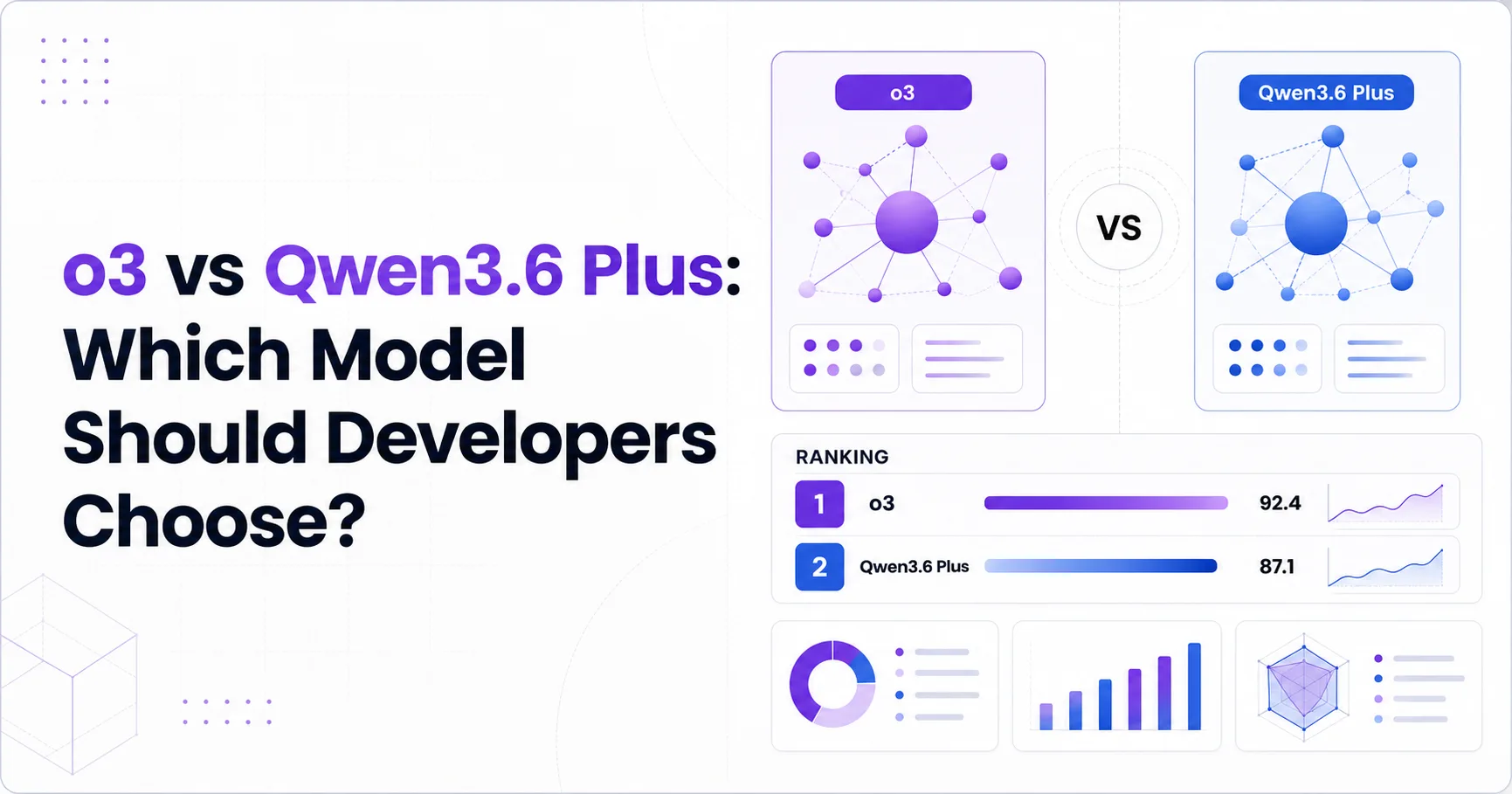
- **Winner overall:** Qwen3.6 Plus, with an Artificial Analysis Intelligence Index of 39.6 vs o3 at 30.4, plus a lower blended price - **Cheaper:** Qwen3.6 Plus at $1.1250000000000002 vs $3.5 per 1M blended tokens - **Faster:** o3 at 128.056 median output tokens per second - **Pick o3 when:** mathematical reasoning and high token throughput matter more than price or documented availability - **Watch out:** neither model has a supplied context-window value, and Qwen3.6 Plus lacks a verifiable source in the supplied research
o3 vs Qwen3.6 Plus at a glance
Qwen3.6 Plus is the stronger measured default for developers who prioritize broad intelligence and lower operating cost. Its Artificial Analysis Intelligence Index is 39.6, compared with 30.4 for o3, while its blended price is $1.1250000000000002 per 1M tokens versus $3.5 for o3. Data provided by https://artificialanalysis.ai/
That conclusion has an important qualification: the supplied evidence does not establish a complete head-to-head capability profile. The dataset reports an Artificial Analysis Math Index of 88.3 for o3, but no corresponding mathematics value for Qwen3.6 Plus. It reports a Coding Index of 54.5 for Qwen3.6 Plus, but no corresponding coding value for o3. The research brief also provides no reliable community tests for either model.
For production selection, developers should therefore treat Qwen3.6 Plus as the measured value and intelligence leader, while treating o3 as the better candidate for mathematics-heavy workloads and high-throughput generation. Availability is a separate risk. The supplied OpenAI model directory does not list o3 among its current models, and the brief contains no verifiable official source for Qwen3.6 Plus.
The decision depends on what the chart cannot prove
Qwen3.6 Plus wins the available broad-intelligence comparison, while o3 wins measured generation speed and has the only supplied mathematics score. The Artificial Analysis Intelligence Index gives Qwen3.6 Plus 39.6 and o3 30.4, but those values do not prove that Qwen3.6 Plus is better for every engineering task. Data provided by https://artificialanalysis.ai/
The most useful distinction is between breadth and specialization. Qwen3.6 Plus has the higher general intelligence measurement and a reported Coding Index of 54.5. o3 has a reported Math Index of 88.3. Because the benchmark coverage is asymmetric, developers cannot infer a coding winner or a mathematics winner from the supplied material alone. The missing counterpart scores are decision-critical evidence gaps.
The deployment picture is also uneven. OpenAI’s current model directory presents GPT-5.6 Sol, GPT-5.6 Terra, and GPT-5.6 Luna as current frontier models, but the supplied page does not list o3 or document a stable alias, endpoint, context window, output limit, or multimodal capability for it. OpenAI model directory Qwen3.6 Plus has no verifiable official release announcement, developer documentation, pricing page, stable alias, or availability statement in the supplied research. This means benchmark leadership should not be confused with procurement certainty.
A practical shortlist is simple. Start with Qwen3.6 Plus for cost-sensitive general development and coding evaluation. Keep o3 in contention for mathematics-heavy reasoning or workflows where its measured output speed has operational value. Confirm live access, terms, limits, and regression behavior before committing either model.
Performance: speed is clear, capability coverage is not
o3 is the better measured choice for fast token generation, while Qwen3.6 Plus has the stronger measured broad-intelligence score. o3 produces a median 128.056 output tokens per second, compared with 55.475 for Qwen3.6 Plus, and both models show 0.3 seconds of latency. Data provided by https://artificialanalysis.ai/
The speed difference matters most after the first response begins. A higher output rate can shorten the visible completion time for long explanations, generated code, and multi-step reasoning traces. It can also improve the experience of interactive developer tools that stream substantial responses. Equal latency means the initial wait does not separate the models in this dataset, so the advantage appears in sustained generation rather than request startup.
Speed does not settle quality. Qwen3.6 Plus has the higher Artificial Analysis Intelligence Index at 39.6, while o3 has the only supplied Math Index, 88.3. Qwen3.6 Plus also has the only supplied Coding Index, 54.5. The dataset therefore supports a speed conclusion, but it does not support a complete task-quality ranking. A developer building code review, debugging, or agent workflows needs direct tests for both models because one model’s missing score cannot be treated as zero or as a tie.
The research brief adds no reliable Reddit, Hacker News, or X material for either model. It therefore cannot confirm coding experience, speed perception, behavioral preferences, or recurring failure cases from community evidence. OpenAI model directory also does not provide the missing o3 benchmark results or detailed limits in the supplied material. Developers should measure time to first token, completion throughput, answer correctness, and recovery from failed tool calls in their own workload before making a latency-driven choice.
Cost: Qwen3.6 Plus is cheaper, but workload shape still matters
Qwen3.6 Plus has the clear listed cost advantage in the supplied dataset, with lower input, output, and blended prices than o3. Its blended price is $1.1250000000000002 per 1M tokens, compared with $3.5 for o3. Data provided by https://artificialanalysis.ai/
The practical effect depends on how an application uses tokens. A system that sends large prompts repeatedly will care about input pricing. A system that asks for long code patches, explanations, or reasoning traces will care about output pricing. Qwen3.6 Plus is listed at $0.5 per 1M input tokens and $3 per 1M output tokens, while o3 is listed at $2 and $8 respectively. The blended comparison captures a supplied 3-to-1 input-to-output mix, but it is not a universal estimate for every application.
A cheaper model can become more expensive in practice if it needs retries, additional validation passes, or longer prompts to reach the required result. The supplied research does not provide failure rates, retry rates, context-window values, or task-level accuracy for either model, so it cannot establish a total-cost winner after quality controls. The same evidence gap prevents a confident claim about whether o3’s higher output speed offsets its higher token price in a latency-sensitive product.
OpenAI’s pricing page does not list o3’s current Standard, Batch, Flex, or Fast mode price in the supplied research. OpenAI API Pricing This creates a serious distinction between the dataset’s comparison price and current procurement certainty. Qwen3.6 Plus has no verifiable pricing source in the research brief either. Use the supplied prices for directional model comparison, then verify the active account-level price and access terms before forecasting spend.
Recommendation for developer model selection
Qwen3.6 Plus is the recommended starting point for general developer workloads, while o3 remains a targeted option for mathematics-heavy and throughput-sensitive tasks. Qwen3.6 Plus leads the supplied broad-intelligence score at 39.6, costs $1.1250000000000002 per 1M blended tokens, and has a reported Coding Index of 54.5. Data provided by https://artificialanalysis.ai/
Choose Qwen3.6 Plus first when the product needs broad reasoning at a lower token cost. This includes applications where many requests must be processed, where input and output volume dominate the budget, or where coding is an important evaluation dimension. The recommendation remains provisional because the supplied material has no verifiable official Qwen3.6 Plus documentation, pricing page, stable alias, or availability statement.
Choose o3 when mathematical reasoning is the decisive requirement or when sustained generation speed has a direct product benefit. o3 has the supplied Math Index of 88.3 and a median output rate of 128.056 tokens per second. The recommendation does not claim that o3 is better at coding, because the research provides no o3 Coding Index. It also does not claim that o3 is currently easy to deploy. The supplied OpenAI model directory does not list o3 among the current models and does not document a stable alias or endpoint. OpenAI model directory
Before adoption, run the same representative prompts against both models. Include mathematical derivations, repository-level code changes, structured output, tool use, refusal behavior, and long responses. Track correctness, retries, latency, output volume, and access stability. The supplied evidence is sufficient for a shortlist, not for a risk-free production verdict.
Questions to answer before adoption
Qwen3.6 Plus is the better provisional default, but neither model has complete evidence for a production decision. The supplied research confirms a broad-intelligence advantage and price advantage for Qwen3.6 Plus, plus a speed and mathematics signal for o3. It does not confirm stable availability, context limits, multimodal support, failure rates, or community behavior for both models.
Developers should separate three questions before selecting a provider: which model performs better on the actual workload, which model can be called reliably under the required terms, and which model remains cheaper after retries and validation. The current materials answer only part of the first question. They do not answer the second question for Qwen3.6 Plus, and they raise an availability concern for o3 because the supplied current OpenAI model directory does not list it. OpenAI model directory
The safest decision is therefore workload-specific. Use the dataset to prioritize tests, not to replace them. Validate the missing benchmark dimensions directly, verify live pricing, and confirm that the exact model identifier remains available before implementation.
Frequently asked questions
Which model should most developers choose first, o3 or Qwen3.6 Plus?
Qwen3.6 Plus should be tested first for most developers because it has the higher supplied intelligence score and lower blended cost, although live availability and workload-specific accuracy remain unverified.
Is o3 better for coding than Qwen3.6 Plus?
The supplied evidence cannot establish that o3 is better for coding because only Qwen3.6 Plus has a reported Coding Index, while no reliable o3 coding benchmark appears in the research.
Is Qwen3.6 Plus faster than o3?
No, o3 is faster in measured output generation, with 128.056 median output tokens per second versus 55.475 for Qwen3.6 Plus, while both have 0.3 seconds of latency.
Why might the cheaper Qwen3.6 Plus still cost more in production?
Qwen3.6 Plus might cost more overall if lower task accuracy causes extra retries, validation calls, or longer prompts, but the supplied research contains no failure-rate evidence to quantify that risk.
Does the supplied research confirm that o3 is currently available?
No, the supplied research does not confirm current o3 availability, a stable alias, or a callable endpoint, and the cited OpenAI model directory does not list o3 among its current models.
Sources
- Artificial Analysis所有模型性能、速度、延迟、价格和评测数据的归属说明
- OpenAI Models核查当前模型目录、o3 可见性、官方定位与可用性证据
- OpenAI API Pricing核查 o3 当前官方挂牌价格与计费模式是否存在
Published: