
Time to First Token · Claude Fable 5 (Adaptive Reasoning, Max Effort, Opus 4.8 Fallback)
57985ms
Time to First Token · GPT-5 (high)
0ms
Deep dive into reasoning, benchmarks, and latency insights.
The current catalog does not contain complete performance evidence for both models, so this page does not declare an overall winner. Use the available fields as comparison signals and validate the models on your own workload.
Key decision metrics at a glance.
| Model | Metric | Value | Unit | Source / snapshot |
|---|---|---|---|---|
| Claude Fable 5 (Adaptive Reasoning, Max Effort, Opus 4.8 Fallback) | Reasoning | 6.0 | benchmark or capability score | Artificial Analysis · current catalog |
| GPT-5 (high) | Reasoning | 9.0 | benchmark or capability score | Artificial Analysis · current catalog |
| Claude Fable 5 (Adaptive Reasoning, Max Effort, Opus 4.8 Fallback) | Coding | 8.0 | benchmark or capability score | Artificial Analysis · current catalog |
| GPT-5 (high) | Coding | 4.0 | benchmark or capability score | Artificial Analysis · current catalog |
| Claude Fable 5 (Adaptive Reasoning, Max Effort, Opus 4.8 Fallback) | Multimodal | 5.0 | benchmark or capability score | Artificial Analysis · current catalog |
| GPT-5 (high) | Multimodal | 3.0 | benchmark or capability score | Artificial Analysis · current catalog |
| Claude Fable 5 (Adaptive Reasoning, Max Effort, Opus 4.8 Fallback) | Long Context | 8.0 | benchmark or capability score | Artificial Analysis · current catalog |
| GPT-5 (high) | Long Context | 4.0 | benchmark or capability score | Artificial Analysis · current catalog |
| Claude Fable 5 (Adaptive Reasoning, Max Effort, Opus 4.8 Fallback) | Blended Price / 1M tokens | $20 | USD per 1M tokens | Artificial Analysis · current catalog |
| GPT-5 (high) | Blended Price / 1M tokens | $3.438 | USD per 1M tokens | Artificial Analysis · current catalog |
| Claude Fable 5 (Adaptive Reasoning, Max Effort, Opus 4.8 Fallback) | P95 Latency | — | milliseconds | Artificial Analysis · current catalog |
| GPT-5 (high) | P95 Latency | — | milliseconds | Artificial Analysis · current catalog |
| Claude Fable 5 (Adaptive Reasoning, Max Effort, Opus 4.8 Fallback) | Tokens per second | 67.465 | tokens per second | Artificial Analysis · current catalog |
| GPT-5 (high) | Tokens per second | 0 | tokens per second | Artificial Analysis · current catalog |
Data provided by Artificial Analysis; live values use the current catalog.
This radar chart visually maps the core capabilities (reasoning, coding, math proxy, multimodal, long context) of `Claude Fable 5 (Adaptive Reasoning, Max Effort, Opus 4.8 Fallback)` vs `GPT-5 (high)`.
This grouped bar chart provides a side-by-side comparison for each benchmark metric.
Lower time to first token is better; higher tokens per second is better.
Compare input and output pricing in USD per 1M tokens.
Claude Fable 5 (Adaptive Reasoning, Max Effort, Opus 4.8 Fallback)$22.5
GPT-5 (high)$3.75
GPT-5 (high) costs $18.75 less per run
This article is a dated snapshot published on 2026-08-06. Live cards above use the current catalog; missing live fields are not inferred.
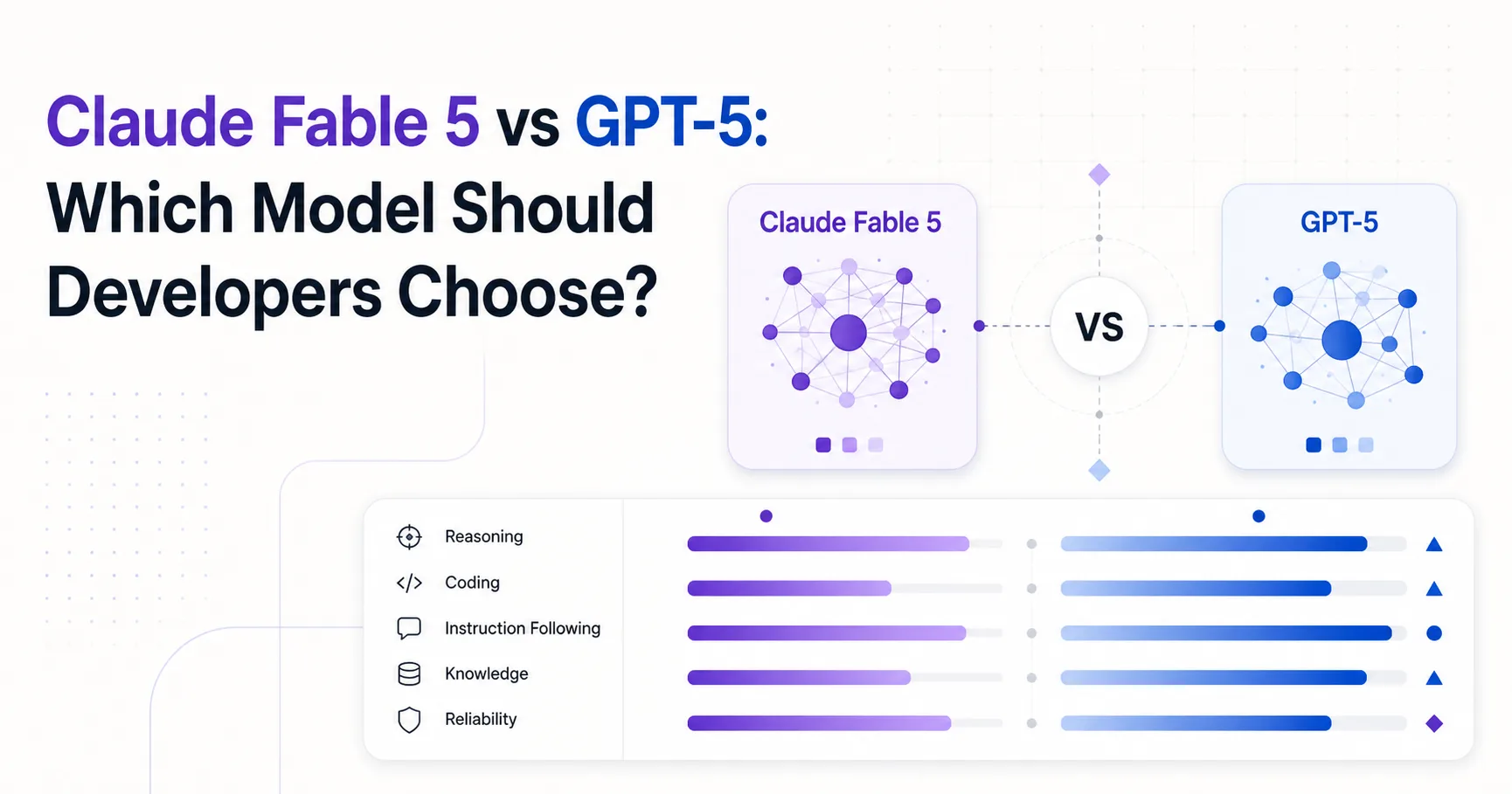
Claude Fable 5 is the stronger general choice for demanding agentic development, while GPT-5 is the stronger choice for cost-sensitive workloads and math-focused tasks. The data brief gives Claude Fable 5 a 76.5 Artificial Analysis coding index and a 59.9 intelligence index, compared with GPT-5 scores of 37.8 and 34.7. GPT-5 has the lower blended price at $3.4375 per 1M tokens, compared with $20 for Claude Fable 5. Claude Fable 5 also has a measured median output speed of 70.509 tokens per second, while the brief provides no corresponding GPT-5 speed value. Both models show 0.3 seconds of measured latency in the data brief. Data provided by https://artificialanalysis.ai/
The comparison is not simply a quality-versus-price decision. Claude Fable 5 is designed for long-running agents and supports adaptive thinking, memory, code execution, context editing, compaction, and programmatic tool calling. Anthropic's model overview and the Fable 5 announcement support that positioning. GPT-5 is positioned around coding, reasoning, and agentic tasks, with controllable reasoning effort, verbosity, structured outputs, and custom tools. OpenAI's developer announcement documents those controls. The best choice depends on whether engineering success, operating cost, or task specialization carries the greatest weight.
Claude Fable 5 offers the stronger measured coding and general intelligence profile, while GPT-5 offers a much lower token price and a notable math result. The coding index gap is 38.7 points, and the intelligence index gap is 25.199999999999996 points in Claude Fable 5's favor. GPT-5 has a math index of 94.3, but the data brief provides no Claude Fable 5 math score, so that result cannot establish a complete head-to-head math winner. Artificial Analysis supplies the comparison data.
| Decision factor | Claude Fable 5 | GPT-5 |
|---|---|---|
| Coding index | 76.5 | 37.8 |
| Intelligence index | 59.9 | 34.7 |
| Math index | Not provided | 94.3 |
| Blended price per 1M tokens | $20 | $3.4375 |
| Latency | 0.3 seconds | 0.3 seconds |
The product controls also differ. Claude Fable 5 always uses adaptive thinking, with effort controlling depth rather than disabling reasoning entirely. Anthropic's effort documentation and thinking documentation describe that behavior. GPT-5 exposes reasoning_effort levels and verbosity, giving developers more direct control over response behavior. OpenAI's model documentation lists those parameters.
The biggest unresolved question is real-world consistency. Community reports describe Claude Fable 5 as highly proactive, but sometimes expensive or slow to settle. GPT-5 reports describe fast small fixes, but weaker completeness in full application generation. Neither source set provides a controlled, repeatable comparison, so deployment testing remains necessary.
Claude Fable 5 is the safer first candidate for complex software agents because its measured coding index is substantially higher than GPT-5's. The difference matters most when a task requires repository-wide reasoning, migration planning, iterative verification, or coordinated tool calls. A higher coding score does not guarantee fewer edits in every codebase, but it gives Claude Fable 5 the stronger starting position for work where failures are expensive.
Claude Fable 5's agent design also matches the kinds of workflows developers often describe as difficult. Anthropic documents memory, code execution, programmatic tool calling, context editing, compaction, vision, and task budgets as supported capabilities. The official Fable 5 documentation describes these features. A Hacker News report describes Claude Fable 5 investigating a complex micropython-wasm problem and producing a wheel for full Python WASM support, although the report did not use a standardized test protocol. The engineering case report is useful evidence of capability shape, not a benchmark.
GPT-5 remains attractive for focused debugging, structured tool use, and tasks where explicit control over reasoning effort and verbosity improves predictability. OpenAI reports official results of 74.9% on SWE-bench Verified, 88% on Aider polyglot, 96.7% on τ²-bench telecom, and 69.6% on Scale MultiChallenge. OpenAI's developer announcement also notes that the SWE-bench result excluded 23 problems from a 500-problem set and that Aider used high reasoning effort. Those qualifications matter when comparing published claims with the Artificial Analysis indices.
The data brief records equal latency of 0.3 seconds, but only Claude Fable 5 has a reported median output speed of 70.509 tokens per second. GPT-5's missing speed value means the available evidence cannot prove which model feels faster in a complete interactive workflow. A Hacker News account of Claude Fable 5 launching browsers, checking windows, taking screenshots, and validating changes also shows why autonomous behavior can increase task duration and cost even when model output is fast. That report is an individual example, not a universal performance measurement.
GPT-5 is the clear price winner for token-heavy applications, with a blended price of $3.4375 per 1M tokens versus $20 for Claude Fable 5. That gap changes the economics of batch classification, routine code edits, high-volume support, and applications that can tolerate more retries or narrower reasoning. OpenAI's pricing information lists GPT-5 input pricing at $1.25 per 1M tokens, cached input at $0.125, and output at $10. Anthropic's pricing documentation lists Claude Fable 5 at $10 per MTok for input and $50 per MTok for output.
The cheaper model can still become more expensive at the application level if it needs additional repair passes, human review, or orchestration around incomplete work. A Reddit user reported that GPT-5 was useful for small debugging tasks but could produce hallucinations or incorrect modifications in complex existing codebases. The GPT-5 community report was not controlled, so it cannot quantify that risk. It does identify the precise cost question developers should test: total cost per accepted change, not only cost per generated token.
Claude Fable 5 has the opposite economic risk. Its autonomous behavior may trigger extra browser checks, screenshots, scripts, and tool calls. One Hacker News report described a task costing about $12, but the report was not a controlled cost test. The cited discussion supports the possibility of tool-driven cost expansion, not a guaranteed average.
Prompt caching can alter the result for applications with repeated context. Anthropic documents cache write prices of $12.50 for 5 minutes and $20 for 1 hour, with cache hits and refreshes at $1 per MTok. OpenAI's listed cached input price is $0.125 per 1M tokens. The correct comparison therefore depends on cache duration, input repetition, output volume, and the number of corrective actions required.
GPT-5 (high) leads on 3 of 3 metrics
Claude Fable 5 is the better default for high-stakes coding agents that must reason across large repositories and verify their own changes. Its coding index of 76.5 versus GPT-5's 37.8 supports that recommendation, while its documented memory, vision, code execution, context management, and programmatic tool features fit long-running workflows. Anthropic's capability documentation describes the relevant controls and tools.
Choose GPT-5 when the application processes large request volumes, has a strict token budget, or benefits from explicit reasoning and verbosity controls. GPT-5's blended price of $3.4375 is materially lower than Claude Fable 5's $20. It also has the only supplied math index, 94.3, so math-heavy workloads should include GPT-5 in the first evaluation round. The missing Claude Fable 5 math score means the data cannot establish whether GPT-5 is genuinely better at math overall.
Use Claude Fable 5 for repository migrations, multi-step debugging, visual inspection, long-context maintenance, and agents expected to continue working without constant user direction. Use GPT-5 for focused patches, structured extraction, cost-sensitive automation, and workloads where the application can impose tighter interaction boundaries. These recommendations reflect the available benchmark and documentation evidence, not a controlled task-level comparison.
Production teams should test accepted-task cost, correction rate, tool-call count, refusal handling, and time to a verified result. Claude Fable 5 can return a refusal through HTTP 200 with stop_reason: "refusal", so callers must inspect the response body rather than rely only on transport errors. Anthropic's refusal guidance documents this behavior. GPT-5 also carries a lifecycle concern because the fixed snapshot gpt-5-2025-08-07 is marked Deprecated, while the stable gpt-5 alias remains listed. OpenAI's model page should be checked before locking a deployment contract.
Claude Fable 5 had an access interruption before service was restored, so teams with strict availability requirements should review provider incident handling and maintain a tested fallback path. Anthropic's redeployment notice records the restoration. The final choice should follow a representative internal workload test because the supplied evidence does not answer reliability, correction rate, or total task cost directly.
Claude Fable 5 is the stronger starting point for autonomous coding agents because the available coding index favors it by 38.7 points. That result still needs confirmation on your repositories, since the data brief does not provide a controlled task-success or correction-rate comparison.
GPT-5 is the better starting point for cost-sensitive production traffic because its blended price is $3.4375 per 1M tokens, compared with $20 for Claude Fable 5. The cheaper rate does not prove lower total operating cost if the model requires more retries, reviews, or corrective edits.
Claude Fable 5 is the better documented fit for multimodal agent workflows because it supports vision, memory, code execution, context editing, compaction, and programmatic tool calling. GPT-5 supports text and image input with text output, but the supplied OpenAI documentation does not describe audio or video support for this API model.
GPT-5 is the only model with a supplied math index, scoring 94.3 in the data brief. The absence of a Claude Fable 5 math score means developers cannot claim a complete math comparison from the available evidence.
Claude Fable 5 requires explicit refusal handling because a refusal can arrive with HTTP 200 and stop_reason: "refusal". GPT-5 requires lifecycle monitoring because its fixed snapshot is marked Deprecated, even though the gpt-5 alias remains available. Both risks should be covered by integration tests and operational alerts.
Choose Claude Fable 5 first for an autonomous coding agent because its coding index is 76.5 versus GPT-5 at 37.8, and its documented tools support memory, code execution, context management, and programmatic tool calling. Validate the choice on representative repositories.
GPT-5 is usually the better token-cost option because its blended price is $3.4375 per 1M tokens versus $20 for Claude Fable 5. It may become more expensive overall if lower task success causes repeated retries, reviews, or corrective edits.
The supplied evidence cannot answer that question because GPT-5 has a math index of 94.3, while no comparable Claude Fable 5 math score is provided. Developers should run a matched math evaluation before making a capability claim.
No, developers should call the gpt-5 model and set reasoning_effort to high; the supplied OpenAI documentation does not identify gpt-5-high as a separate API model alias.
Claude Fable 5 requires careful monitoring of refusal responses and tool activity because refusals can arrive through HTTP 200, while autonomous browser checks and scripts may increase task cost. The available reports demonstrate these risks but do not quantify their frequency.