
Time to First Token · Claude Opus 5 (Adaptive Reasoning, Low Effort)
3182ms
Time to First Token · GPT-5 mini (high)
0ms
Deep dive into reasoning, benchmarks, and latency insights.
The current catalog does not contain complete performance evidence for both models, so this page does not declare an overall winner. Use the available fields as comparison signals and validate the models on your own workload.
Key decision metrics at a glance.
| Model | Metric | Value | Unit | Source / snapshot |
|---|---|---|---|---|
| Claude Opus 5 (Adaptive Reasoning, Low Effort) | Reasoning | 6.0 | benchmark or capability score | Artificial Analysis · current catalog |
| GPT-5 mini (high) | Reasoning | 9.0 | benchmark or capability score | Artificial Analysis · current catalog |
| Claude Opus 5 (Adaptive Reasoning, Low Effort) | Coding | 7.0 | benchmark or capability score | Artificial Analysis · current catalog |
| GPT-5 mini (high) | Coding | 2.0 | benchmark or capability score | Artificial Analysis · current catalog |
| Claude Opus 5 (Adaptive Reasoning, Low Effort) | Multimodal | 4.0 | benchmark or capability score | Artificial Analysis · current catalog |
| GPT-5 mini (high) | Multimodal | 2.0 | benchmark or capability score | Artificial Analysis · current catalog |
| Claude Opus 5 (Adaptive Reasoning, Low Effort) | Long Context | 7.0 | benchmark or capability score | Artificial Analysis · current catalog |
| GPT-5 mini (high) | Long Context | 3.0 | benchmark or capability score | Artificial Analysis · current catalog |
| Claude Opus 5 (Adaptive Reasoning, Low Effort) | Blended Price / 1M tokens | $10 | USD per 1M tokens | Artificial Analysis · current catalog |
| GPT-5 mini (high) | Blended Price / 1M tokens | $0.688 | USD per 1M tokens | Artificial Analysis · current catalog |
| Claude Opus 5 (Adaptive Reasoning, Low Effort) | P95 Latency | — | milliseconds | Artificial Analysis · current catalog |
| GPT-5 mini (high) | P95 Latency | — | milliseconds | Artificial Analysis · current catalog |
| Claude Opus 5 (Adaptive Reasoning, Low Effort) | Tokens per second | 50.072 | tokens per second | Artificial Analysis · current catalog |
| GPT-5 mini (high) | Tokens per second | 0 | tokens per second | Artificial Analysis · current catalog |
Data provided by Artificial Analysis; live values use the current catalog.
This radar chart visually maps the core capabilities (reasoning, coding, math proxy, multimodal, long context) of `Claude Opus 5 (Adaptive Reasoning, Low Effort)` vs `GPT-5 mini (high)`.
This grouped bar chart provides a side-by-side comparison for each benchmark metric.
Lower time to first token is better; higher tokens per second is better.
Compare input and output pricing in USD per 1M tokens.
Claude Opus 5 (Adaptive Reasoning, Low Effort)$11.25
GPT-5 mini (high)$0.75
GPT-5 mini (high) costs $10.5 less per run
This article is a dated snapshot published on 2026-08-07. Live cards above use the current catalog; missing live fields are not inferred.
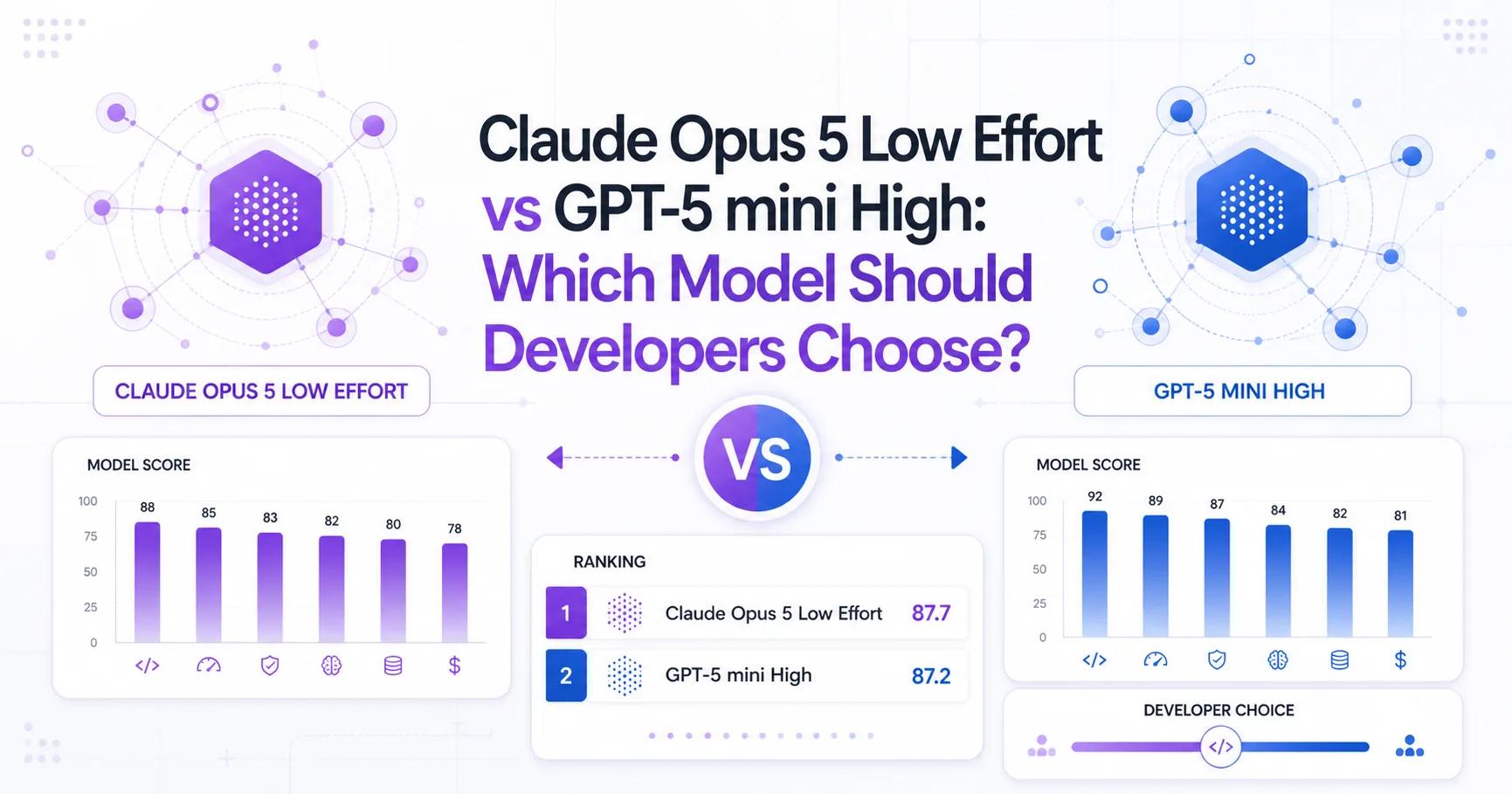
Claude Opus 5 (Adaptive Reasoning, Low Effort) is the stronger documented choice for demanding software work, while GPT-5 mini (high) is the dramatically cheaper option with important evidence gaps. The comparison is not a simple contest between two equally documented API products. Anthropic publishes a stable model identity, operating constraints, pricing, and deployment options for Claude Opus 5 in its model overview. OpenAI's current model directory does not list gpt-5-mini as an independent entry. Artificial Analysis data still reports benchmark and price observations for both models, so the practical decision requires separating measured capability from confirmed production availability. Claude Opus 5 is the safer default for complex coding agents. GPT-5 mini remains attractive for high-volume workloads, but its current contract must be verified before adoption.
Claude Opus 5 (Adaptive Reasoning, Low Effort) offers the stronger measured general and coding performance, while GPT-5 mini (high) offers the lower cost by a wide margin. Artificial Analysis reports a coding index of 66.9 for Claude Opus 5 and 15.6 for GPT-5 mini. Its intelligence index is 50.6 versus 25.3. These scores suggest a meaningful advantage for repository-level coding, multi-step implementation, and tasks where the model must maintain a plan across tool calls. They do not prove that Claude will win every prompt, because the benchmark methodology and task distribution are not supplied in the brief.
GPT-5 mini has one reported area of strength: its math index is 90.7, while no corresponding Claude value is provided. That result is not enough to establish a broad mathematical advantage, because the comparison is incomplete. Cost is the clearest GPT-5 mini advantage. Its blended price is $0.6875 per 1M tokens, compared with $10 for Claude Opus 5. Claude's official pricing page confirms $5 input and $25 output pricing, while the cited OpenAI pricing page does not list GPT-5 mini.
The main selection question is therefore operational: do you need a documented model contract and stronger coding evidence, or do you need the lowest observed token cost? For production systems, the answer should include an API availability test, not only a benchmark ranking.
Claude Opus 5 (Adaptive Reasoning, Low Effort) is the better-supported performance choice for complex coding and agentic tasks, but low effort introduces a quality tradeoff. The coding-index gap is large enough to matter when a task requires repository navigation, architectural reasoning, tool selection, and a coherent patch rather than an isolated code completion. A higher score does not guarantee fewer defects, because the brief provides no task-level error analysis or controlled production study.
Anthropic describes Claude Opus 5 as a model for complex agentic coding and enterprise work in its official model overview. The effort documentation says low effort usually reduces thinking, tool calls, latency, and cost, while potentially reducing capability. That makes the selected configuration a compromise, not the model's maximum-quality mode. Developers should evaluate whether low effort preserves the reliability needed for their own repositories.
Claude Opus 5 also has a reported median output rate of 55.017 tokens per second. GPT-5 mini has no corresponding speed value in the data brief, so no fair output-throughput winner can be established. Both models show 0.3 seconds for the reported latency field, which makes initial responsiveness appear tied in this dataset, but it does not describe full task completion time.
Community evidence adds caution rather than a definitive reversal. Reddit users disagree about whether Opus 5 is effective or overly slow and verbose in this discussion. A Hacker News report describes missed deployment instructions in one project at this thread. Both are anecdotal, so they should inform test design, not replace it.
GPT-5 mini (high) is the clear observed cost winner, but its lower token price does not establish a lower total system cost. Artificial Analysis reports $0.6875 per 1M blended tokens for GPT-5 mini and $10 for Claude Opus 5. That difference makes GPT-5 mini compelling for large request volumes, routine transformations, and workloads where retries are rare and quality requirements are narrow.
The economic risk is failure amplification. A cheaper request can cost more if it produces an incorrect patch, ignores repository constraints, requires repeated repair calls, or triggers expensive human review. The available evidence does not quantify either model's production error rate, retry rate, or review burden. Developers should therefore compare cost per accepted outcome, not token price alone.
Claude Opus 5's official pricing documentation includes prompt caching, with cache-hit pricing of $0.50 per 1M tokens and a minimum cacheable prompt length of 512 tokens. Those mechanics may matter for agents that repeatedly send stable repository instructions or large project context. The brief provides no equivalent GPT-5 mini caching details. OpenAI's pricing documentation also does not list GPT-5 mini, so its observed price should be treated as a dataset value requiring current account-level verification.
The cost conclusion can flip when quality gates are strict. GPT-5 mini is the better first candidate for inexpensive bulk work. Claude Opus 5 may be cheaper per successful change if its coding advantage materially reduces rework, but that claim remains unproven without an evaluation using the target codebase.
GPT-5 mini (high) leads on 3 of 3 metrics
Claude Opus 5 (Adaptive Reasoning, Low Effort) should be the default candidate for high-consequence coding agents, while GPT-5 mini (high) should be tested first for cost-sensitive, well-bounded work. Choose Claude when the model must understand an unfamiliar repository, follow architectural constraints, coordinate several tools, or produce changes that are expensive to review manually. Anthropic documents support for text and image input, text output, multilingual capability, and visual understanding in its model overview. Its listed deployment paths include Claude API, Amazon Bedrock, Google Cloud, and Microsoft Foundry.
Choose GPT-5 mini when requests are short, repetitive, easy to validate automatically, or dominated by a strict budget. Its reported math index of 90.7 makes it worth testing for math-heavy workloads, but the brief does not provide a matching Claude score or a methodology detailed enough to generalize that result. The current OpenAI documentation does not confirm the model's API identity, context limit, output limit, tool support, pricing, or the meaning of the high label. That uncertainty is itself a production risk.
The safest rollout is staged. First, verify that the exact GPT-5 mini identifier is callable in the intended account and region. Next, test both configurations on representative coding tasks with acceptance checks, repair counts, latency measurements, and reviewer effort. Finally, compare cost per accepted result. Anthropic advises starting with high effort before lowering it in the effort guide, so low effort should be treated as an optimization to validate rather than an assumed baseline.
Claude Opus 5 is currently listed as Active with an earliest expected retirement date of 2027-07-24 in the model deprecations documentation. That gives it a clearer lifecycle signal than the available GPT-5 mini materials. It does not remove the need for service monitoring: Anthropic recorded an Opus 5 elevated-errors incident in its status report.
GPT-5 mini (high) cannot be selected confidently from public documentation alone because the cited OpenAI model directory does not provide a dedicated current entry. The following questions focus on the decisions that the supplied evidence can support, while marking the areas where it cannot.
Claude Opus 5 (Adaptive Reasoning, Low Effort) is the stronger candidate for coding agents because its reported coding index is 66.9 versus 15.6 for GPT-5 mini. Developers should still validate low effort on their own repositories, since Anthropic says reduced effort can reduce complex-task capability and the brief provides no production error study.
GPT-5 mini (high) is cheaper according to the supplied data, at $0.6875 per 1M blended tokens versus $10 for Claude Opus 5. That price advantage can disappear if weaker outputs cause more retries, repair calls, failed evaluations, or human review, none of which are quantified here.
Claude Opus 5 (Adaptive Reasoning, Low Effort) has a reported median output speed of 55.017 tokens per second, while GPT-5 mini has no reported value. The latency field is 0.3 seconds for both models, so the available evidence cannot establish a complete end-to-end speed winner.
GPT-5 mini's current API availability is not confirmed by the cited OpenAI documentation because the current model directory and pricing page do not list it independently. The data brief reports observations for the model, but developers should verify the exact identifier, limits, pricing, and access in their intended deployment environment.
GPT-5 mini (high) has a reported math index of 90.7, but that result does not prove broader reasoning superiority. The brief provides no corresponding Claude math value, no complete benchmark methodology, and stronger reported Claude results on the available coding and intelligence indices.